
Poinsett County Arrest Warrants Explained
Two rules do the heavy lifting here. Arkansas Code § 16-81-104 lets a circuit judge, district judge, or magistrate issue an arrest warrant when personal knowledge or sworn information gives reasonable grounds for the charge, and Arkansas Rule of Criminal Procedure 7.1 governs how issuance works. The signed order tells an authorized officer to arrest the person and bring them before the proper judge or magistrate. In practice the process usually starts with a written information, complaint, or affidavit sworn by a prosecuting attorney or another credible complainant. The judicial officer weighs those facts, ties them to a specific charge, and signs only if the legal standard is met. Poinsett County District Court's administrative plan also recognizes its district judges' authority to issue warrants, make reasonable-cause findings, hold first appearances, provide counsel information, and run pretrial-release inquiries. So in Poinsett County, both court levels can put a warrant in motion.
Poinsett Arrest Warrant Issuance Path
One Poinsett County warrant can pass through many hands before the case ends. A complaint goes to a judge or magistrate first. Once signed, the order enters court and law-enforcement systems, an officer serves it, detention staff book the arrest, and the court logs the first appearance, bond, service, or recall. That split among custodians is why a single website often shows less than the full court file.
- An officer, prosecutor, or credible complainant supplies sworn facts.
- A judicial officer decides whether reasonable grounds support process.
- The warrant enters court and authorized law-enforcement channels.
- Service leads to booking and a court-controlled release decision.
Arkansas materials also describe a recorded oral process when circumstances make a written affidavit unreasonable. Either way, judicial authorization stays essential in Poinsett County.
Inside a Poinsett County Arrest Warrant
A Poinsett County warrant document and its docket usually carry more than the sheriff's public card. Search ARCourts may list the court, offense, statute, event, bond, and filed documents. The sheriff cards, by contrast, show only age, date, bond, and charge text. Ask for the case or cause number, because a name match alone proves little.
| Warrant or case number | A unique court-assigned number, not exposed on sampled sheriff cards. |
|---|---|
| Named subject | The legal name, which should be checked with another identifier. |
| Charge or offense | The alleged offense, statute, and classification. |
| Issuing judge or court | The Circuit Court or District Court department controlling the order. |
| Bond or hold | Amount and type, or a no-bond flag. Blank and $0.00 values require a call. |
| Issue and service dates | Dates distinguishing issuance from execution, recall, or later action. |
Poinsett County Felony Case Search
The official Search ARCourts participant search pairs well with the Poinsett County warrant list. It accepts first, middle, and last name, an organization, or a case description. A public docket there can expose the case number, court, judge, charge, statute, filing date, bond, documents, and events like arrest warrant issued, warrant served, bond forfeiture, or recall. But a docket is not a live active-warrant roster. An old issuance event can sit on the docket long after service or recall, and sealed documents may not appear at all. Write down the case number and issuing court, then ask the clerk in Poinsett County whether the warrant is still active and what step the court authorizes next.
Serving Arrest Warrants in Poinsett County
Arkansas law lets law-enforcement officers execute warrants within their authority. The Poinsett County Sheriff's Office handles the countywide warrant list and the detention center. Police in Harrisburg, Trumann, Marked Tree, Lepanto, and Tyronza run their own municipal agencies. State or federal officers may also serve authorized process in their jurisdiction, and public records won't tell you which unit holds any single warrant. After service comes identification and booking, then a first appearance and a court-controlled bond decision. The official detention page says the center houses people arrested on warrants and awaiting trial, but it posts no bond schedule or fixed first-appearance timetable. For current routing, call the 24-hour non-emergency line at 870-578-2116. A call does not shield anyone from arrest.
Poinsett County Bond Displays
The Poinsett County sheriff list can show several amounts, a blank, or $0.00 on the same card. None of that is a bond schedule. The figure may reflect separate charges, incomplete data, a court-set amount, or a hold where payment alone is not enough. Confirm the amount, type, and case number with detention and the issuing court.
- Cash bond
- Money posted under current court or detention instructions.
- Surety bond
- A licensed company guarantees appearance for its contractual fee.
- Personal recognizance
- Judge-authorized release on a promise and conditions.
- No-bond or hold
- A status requiring action beyond simple payment.
Poinsett County publishes no official bond schedule, online bond portal, or processing fee. Bond secures a later appearance; it does not dismiss the charge.
Poinsett Detention After Warrant Service
The sheriff's detention material fills in what happens after service. The official detention page states that the Poinsett County center houses people arrested on warrants, people awaiting trial, people serving municipal-court sentences, and people held for other agencies.
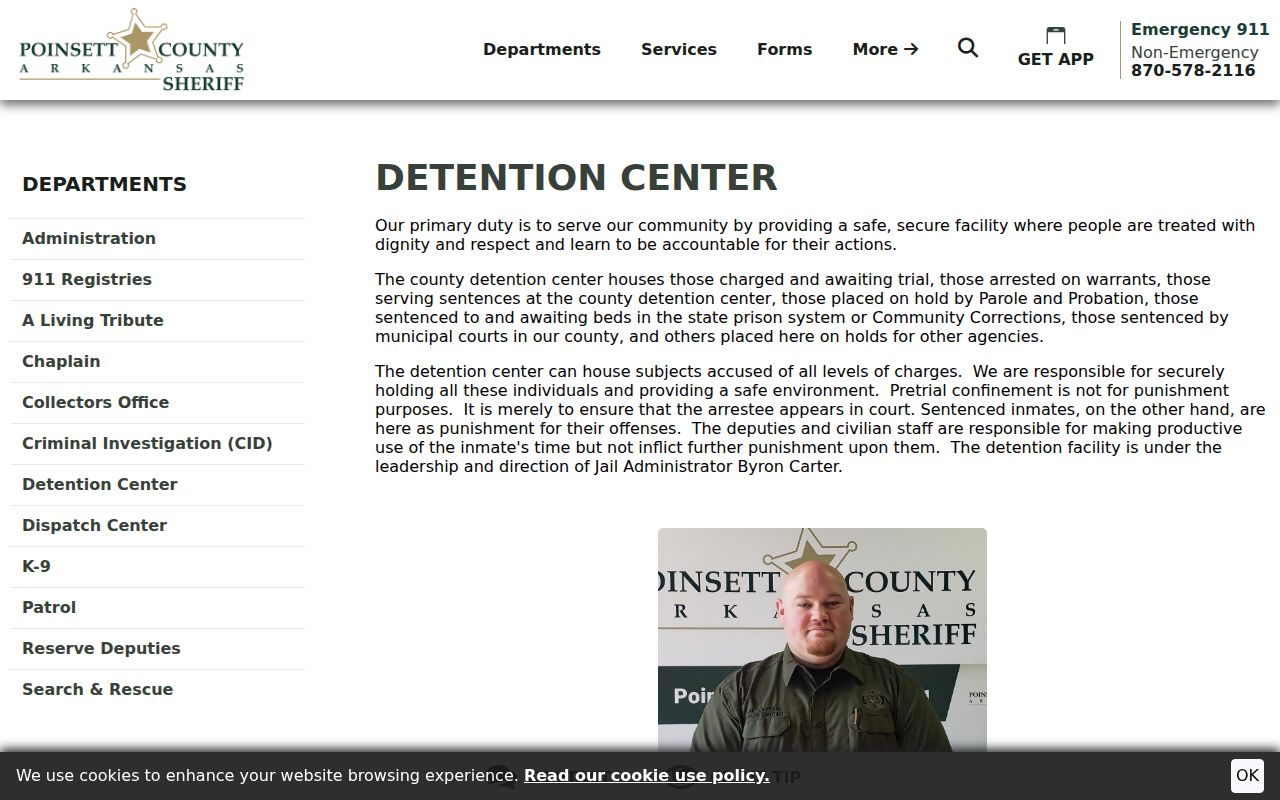
The county detention center answers custody questions, but its inmate card settles little about any one case. Poinsett County publishes no full bond menu there, no list of accepted payments, no bond-window hours, and no set time to a first appearance. Ask detention staff directly which court holds the case and whether more than one charge or agency is attached. Also ask which bond type the judge authorized. Those details control what happens next.
Once release comes, follow every required court date through Search ARCourts and the issuing clerk. A served warrant can sit on the docket as a historical event while the prosecution moves ahead. An online card may lag behind service or a recall too. Written release papers and court documents beat anything pulled from a web page, so keep copies.
Comparing Poinsett County Arrest Warrants
An arrest warrant starts with sworn allegations and a judge's review. A summons orders an appearance without custody. A bench warrant follows a missed court date or a disobeyed court duty. Poinsett County's list may flatten these into a single reason line, so only the issuing court can define the process.
| Feature | Arrest Warrant | Summons | Bench Warrant |
|---|---|---|---|
| What it orders | Arrest and delivery to court | Appearance on a date | Arrest for a missed duty |
| Basis | Sworn facts supporting an offense | A case proceeding without initial custody | Failure to appear, pay, or comply |
| Issuer | Judge or magistrate | Court process | Court controlling the case |
| Response | Counsel, surrender, bond | Appear as directed | Reset, recall, bond, appearance |
Sealed Poinsett County Warrant Records
A blank search result in Poinsett County proves nothing. Arkansas FOIA lets agencies hold back undisclosed investigations and records shielded by court order, and juvenile files stay confidential. So an unserved warrant, a sealed complaint, or a juvenile case may never show up like an ordinary public docket entry.
Key point: A clean name search is only a search result, not an official clearance from the court or sheriff.
Arkansas FOIA lets you request Poinsett County records in person, by phone, mail, fax, email, or another accepted method. Ask for enough detail to show your warrant number, issuing court, date, reason, current status, and bond. Agencies generally get up to three business days to respond, subject to exemptions.
Confirming a Poinsett Arrest Warrant
Start with the official sheriff warrant search, which takes a first or last name and offers name and date views, sorting, Search, Show All, and pagination. It is thin on detail. There are no fields for DOB, warrant number, case number, issuing court, judge, or status, and its disclaimer says the office cannot certify accuracy or authenticity. For a firmer answer on a Poinsett County warrant, call 870-578-2116. Circuit Clerk Misty Russell handles felony circuit files at 401 Market Street, 870-578-4420, while a preliminary matter may sit in Harrisburg, Trumann, Marked Tree, Lepanto, or Tyronza District Court. Have the legal name, DOB, case or citation number, and any notice handy, but skip sending sensitive data through plain email.
Poinsett Arrest Records by Custodian
The right contact depends on the case, not on which website produced a match. Circuit Clerk Misty Russell keeps the Second Judicial Circuit's Poinsett County criminal files, including the felony case record behind a circuit warrant. Each of the five District Court clerks holds traffic, misdemeanor, ordinance, and preliminary-felony records for its own department. The sheriff, meanwhile, maintains the public operational list, serves county process, and fields detention questions. The County Clerk is a separate administrative and probate official, not the primary criminal-warrant file custodian in Poinsett County.
When a clerk comes up empty, give the full legal name, DOB, approximate issue date, charge wording, and any case or citation number, and ask whether the file belongs to another department. For an accessible record that is not online, send a narrow Arkansas Freedom of Information Act request to the custodian who controls it, asking for records sufficient to show the warrant number, issuing court, issue date, current status, bond, service, and recall date. Broad demands for every warrant record in the county help less than one tight request aimed at resolving a single person's matter.
Restrictions still apply. Court-order-protected material, juvenile records, and undisclosed investigations may be sealed, withheld, or redacted. A custodian can explain that a record is exempt or redirect the request, but a public employee cannot give legal advice. If the underlying process may still be active, a Poinsett County defense lawyer can deal with the court and the prosecutor directly instead of leaning on an informal web interpretation.
If There Is a Poinsett Arrest Warrant for You
Confirm the order and identify its issuing court before you walk into any Poinsett County office. Ask a defense attorney whether counsel can arrange an appearance, a motion to recall or quash, a surrender time, and bond. Only the issuing court can say whether an order, hearing, appearance, or recall is required, and federal or out-of-state warrants follow the issuing jurisdiction's route. If surrender is authorized, call ahead, bring the requested identification, and line up transportation and care duties. Verify which bond terms apply, whether cash, surety, personal recognizance, or no-bond conditions. Keep every receipt and signed order, then confirm the court and sheriff records were updated. Remember that payment or bond does not end the case.
Important: Speak with a lawyer before surrendering because an active warrant can result in arrest during any lawful police contact.